
Working an earnings call with AI
From the transcript drop to a one-page memo in under an hour, with every number traceable to a line in the source.
- Platform
- Claude
- Time
- 45 minutes per company
- Level
- Intermediate
This guide goes from a raw earnings transcript to a one-page memo in about 45 minutes using Claude: pull the guidance change and the dodged questions, verify every quote against the transcript, diff the two latest 10-Ks, steelman your read, then write the memo with every number traceable to a source.
New guides go to subscribers first. Get the next one by email →
What you need
- A Claude account (Pro for long transcripts and multiple files)
- The call transcript (company IR site, or your data provider)
- This year's and last year's 10-K as PDFs, from EDGAR
Steps
Get the transcript, not a summary
Download the full transcript from the company's investor relations page or your data provider. News summaries are already someone's opinion; you want the raw Q&A.
Pull the guidance change and the dodged questions
Start a new Claude chat, attach the transcript and run Prompt #006. The third item, questions management didn't answer, is usually the most useful. Keep the output; you'll feed it into the memo.
Here is an earnings call transcript. Tell me: 1) how guidance changed versus last quarter, 2) the three things analysts pushed hardest on, 3) any question management didn't really answer. Quote the exact lines. No opinion on the stock.
Verify every quote
Search the transcript for each quoted line. If a quote isn't there word for word, throw out that point. This takes five minutes and it's the step people skip.
For each quote above, give me the speaker name and the exact sentence as it appears in the transcript, with nothing paraphrased.
Diff the filings
In a second chat, attach both 10-Ks and run Prompt #009. You're looking for new risk factors and softened language in the outlook. Reworded sentences matter more than new ones.
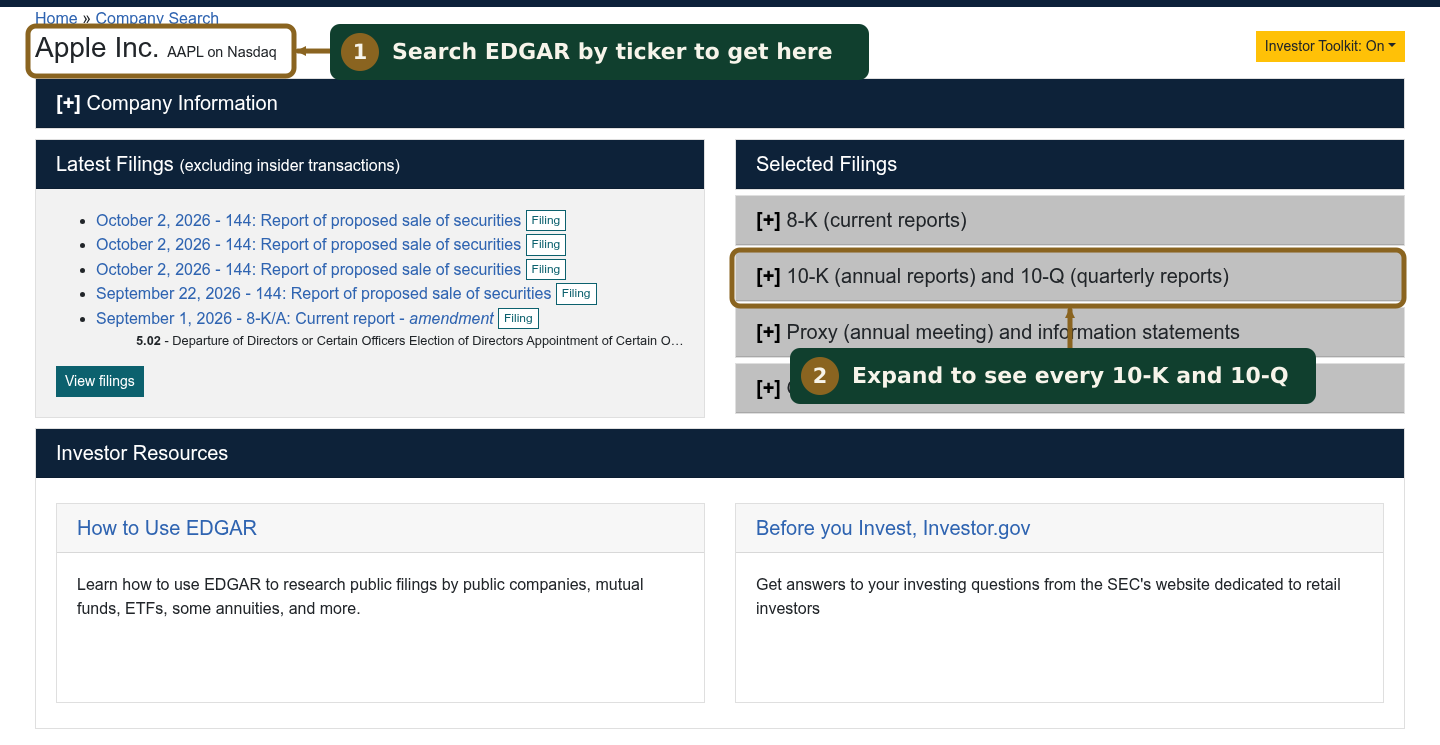
On EDGAR, search the ticker, then expand 10-K and 10-Q under Selected Filings to download both years. Attached are this year's and last year's 10-K for [company]. Compare the risk factors and outlook sections. List what was added, what was removed and what was reworded, with the old and new sentence side by side. Skip boilerplate that didn't change.
Steelman your read
Write your takeaway in two sentences, then run Prompt #007 against it. If the strongest counter-argument uses facts from the call you'd skipped, go back to step 2.
Here is my thesis: [paste thesis]. Give me the strongest case against it in five bullets, then tell me the one piece of evidence that would prove me wrong. Do not tell me whether to buy or sell.
Write the memo
Paste the outputs from steps 2, 4 and 5 into one chat along with your own notes, and run Prompt #014. Read the one-page result against your notes. Anything in the memo that isn't in your notes gets deleted.
Turn the attached analysis into a one-page memo. Put the decision you need from the reader in the first line. Then: context in three sentences, the numbers that matter in one table, risks in three bullets, and the recommendation. Keep everything that's in my notes and add nothing that isn't.
Before you rely on it
- Every quote in the memo appears verbatim in the transcript
- Guidance change is stated as old number, new number
- At least one point in the memo came from the 10-K diff, not the call
- The memo contains no number you can't trace to a source
- No buy or sell call from the model anywhere in the chain
Used in this guide
Frequently asked questions
- Can AI summarise an earnings call accurately?
- It can pull the guidance change, the repeated lines and the questions management did not answer. Accuracy depends on step three: search the transcript for every quote and throw out any point whose quote is not there word for word.
- Where do I get the full earnings call transcript?
- The company's investor relations page or your data provider. Use the full transcript with the Q&A, not a news summary; a summary is already someone else's read.
- Why diff the 10-Ks as well as reading the call?
- New risk factors and softened outlook language appear in the filing before they are said out loud. Reworded sentences matter more than new ones, and at least one point in the memo should come from the filing diff.
- How long does working an earnings call with AI take?
- About 45 minutes per company, including the verification and the memo. Most of the time saved is on the first read of the transcript; the checks are the part you should not compress.
- Should the AI give me a buy or sell call?
- No, and the guide's final check is that there is none anywhere in the chain. The model extracts, compares and challenges; the call is yours.
Get the next guide first
Hands Off is a free newsletter on AI tools for traders and finance professionals, twice a week. New guides, prompts and shortlists go to subscribers before they go anywhere else.
This guide is an editorial walkthrough, not a tested configuration and not financial advice. Review anything a model produces before you act on it.